

Article
78 performance review phrases to share effective feedback
Performance management
18 min read
Written by

The employee experience platform
So you’ve hired great talent. They show up, and they’re engaged in the work they’re doing. You see their critical thinking skills as a strength your business can leverage. Only now, you’re facing weird market conditions and making scarcity-based decisions. Those same engaged employees are turning that critical eye on your strategy.
These teams still bring energy to their work, support their teammates, and want the company to succeed. But beneath that commitment is a growing frustration that quickly devolves to skepticism. Employees aren’t convinced the company has what it takes to succeed.
To help organizations understand the relationship between employee engagement and confidence in business performance, Culture Amp created the Performance Culture Quadrant™ (PCQ). By mapping engagement against performance confidence, the PCQ framework identifies four distinct culture states: Peak Performance, Engaged Skepticism, Strained, and Disconnected.
When our people science teams asked HR leaders where they thought their HR team would fall across those four quadrants, the majority predicted engaged skepticism.
In this article, we’ll focus on Engaged Skepticism, share how to tell if your workforce falls into this quadrant, and explore how to build the clarity, accountability, and alignment needed to reach Peak Performance.
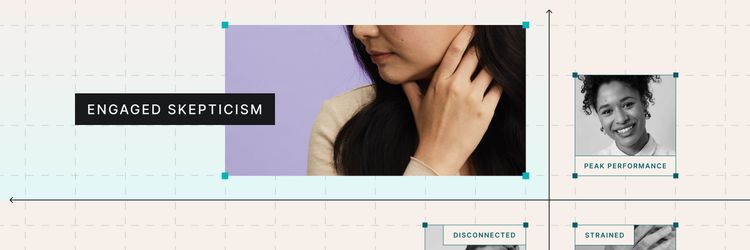
Engaged Skepticism work cultures are characterized by high engagement but low confidence in organizational performance. Employees have doubts about the company’s ability to succeed – not because they’ve stopped caring, but because they care enough to recognize what isn’t working.
Unlike Disconnected cultures, where employees may feel detached or disengaged, Engaged Skepticism cultures still have a strong dedication and connection to the work. Employees believe in the mission, want the organization to succeed, and bring energy to their work. The challenge is that they often experience friction between what the organization says it wants to achieve and what they see happening day to day. As a result, they lack company confidence.
Because employees in Engaged Skepticism cultures are still highly engaged, the warning signs can be easy to miss.
Consider the following reflection questions and whether they might apply to your work culture:
Do cross-functional projects stall because teams disagree on ownership, priorities, or decision-making authority?
Rather than raising red flags, do employees band together to solve complex problems in silos, effectively cutting the rest of the org out of their workflows and solutions?
Do employees enthusiastically support your company’s mission, but openly question whether leadership can execute on it?
When priorities change, do teams feel frustrated rather than inspired because they’ve seen too many initiatives lose momentum?
During 1-on-1s, are high-performing employees spending more time navigating internal friction than building out meaningful work?
Do leaders pivot to new goals before measuring progress made on the last set they shared out?
Have employees stopped pitching improvements and started saving their energy only for the work that is right in front of them?
If you answered “yes” to most of the questions above, your organization may be operating in a culture of Engaged Skepticism. The good news is that this cultural state is highly recoverable. Employees are already engaged and invested in the organization’s success; you just need to strengthen operational confidence, and you’ll be well on your way to Peak Performance.

To move from Engaged Skepticism to Peak Performance, you must improve employees’ confidence in your organization’s ability to strategize and execute effectively.
Employees need to believe that leadership can turn strategy into action, align teams around shared goals, and consistently deliver on commitments. When people trust that the organization can follow through, skepticism begins to give way to confidence.
Our research found that organizations that successfully moved from Engaged Skepticism to Peak Performance within one year improved by 7-12 percentage points in two key areas: accountability and cross-departmental collaboration.
Now, let's take a closer look at how strengthening these areas can help your organization rebuild operational confidence.
Employees lose confidence when priorities change, initiatives stall, and no one takes responsibility for the outcome.
In Engaged Skepticism cultures, people often believe in the organization's goals but question whether it can execute effectively. They're tired of seeing promising ideas lose momentum, strategic initiatives quietly disappear, and important issues remain unresolved. Over time, these experiences plant a seed of doubt in employees, who are left wondering if the organization can ever follow through on commitments.
Building accountability can restore that confidence. Employees need to understand who owns key initiatives, how success will be measured, and what happens when progress stalls. Clear ownership, transparent decision-making, consistent follow-through, and acknowledgment of past failures all demonstrate that your organization is serious this time around.
One of the most visible ways leaders can demonstrate accountability? Acting on employee feedback.
Regular employee surveys provide valuable insight into what's helping or hindering performance, but collecting feedback is only the first step. Organizations build trust when they share survey results, communicate action plans, and provide regular updates on progress. When employees see leaders taking responsibility for outcomes and following through on commitments, confidence can grow. Over time, that accountability helps employees believe the organization can execute on its strategy and deliver on its goals.
Silos and competing team priorities can frustrate employees. In Engaged Skepticism cultures, employees often feel like different parts of the organization are moving in different directions. Teams may duplicate work, struggle to make decisions efficiently, or become frustrated by unclear ownership across projects and initiatives.
Organizations can strengthen alignment by:
Clarifying decision-making authority across teams
Establishing shared goals and success metrics
Improving visibility into organizational priorities
Reducing competing initiatives
Creating stronger communication channels between departments
Defining ownership and accountability for cross-functional work
Giving teams the tools and processes they need to collaborate effectively
When employees see teams moving in the same direction and working toward shared outcomes, confidence grows. Improved organizational alignment helps employees trust that the business can execute on its strategy – not just talk about it.
Engaged Skepticism cultures are in a uniquely positive position: Your employees care. They believe in your mission, want to help their teammates, and are rooting for the future of the organization. The challenge lies in showing them that your business can execute successfully enough to achieve its goals.
Moving from Engaged Skepticism to Peak Performance requires creating the clarity, accountability, and alignment needed to build that operational momentum. By listening to employees, improving collaboration, and building confidence in execution, organizations can turn skepticism into one of their greatest competitive advantages.
Turn skepticism into confidence by exploring Culture Amp’s Performance Culture Quadrant™ and starting your 12-month journey to Peak Performance today.

Unlock the 47% advantage: A guide for modern leaders.
Article
Article
Article