
Article
78 performance review phrases to share effective feedback
Performance management
18 min read

Written by

The employee experience platform
When an organization faces economic challenges, company culture often slips down the list of priorities. Tight budgets and pressure to deliver results can push organizations to focus on outcomes rather than culture. But making performance your company’s only priority can backfire in the long run.
Organizations that neglect culture are likely to see falling engagement, fading motivation, and eroding trust – and eventually, performance is bound to suffer, too. If you think your organization might be on this path, it’s time to pause and take a deeper look at your culture.
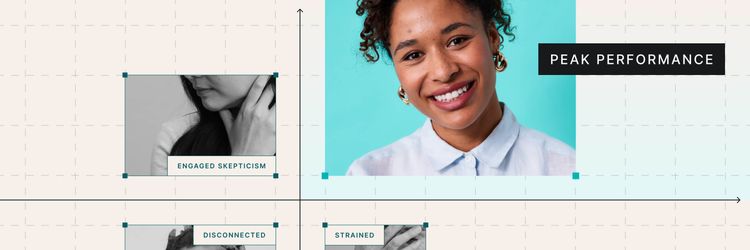
To help organizations understand their current culture and how to strengthen it, Culture Amp created the Performance Culture Quadrant (PCQ). By mapping employee engagement against confidence in organizational performance, the PCQ framework puts companies into one of four distinct culture types: Peak Performance, Engaged Skepticism, Strained, and Disconnected.
This article focuses on the lower left quadrant: Disconnected cultures. We’ll explore the warning signs leaders can’t afford to ignore, why Disconnected cultures struggle to build trust, and what organizations can do to move toward a thriving Peak Performance state.
Disconnected cultures are characterized by both low engagement and low confidence in organizational performance. Employees in these workplaces are likely feeling undersupported, and they may not believe the organization is moving in the right direction. Over time, workplaces with Disconnected cultures risk trust diminishing exponentially, especially if day-to-day work starts to feel more transactional than meaningful.
In this environment, the workplace behaviors employers want to avoid (like quiet quitting and job hugging) may become more common. The overall tenor of Disconnected cultures is that employees feel detached from their company’s culture and disengaged from their work, doing only what’s required of them while they bide their time in search of a better opportunity elsewhere.
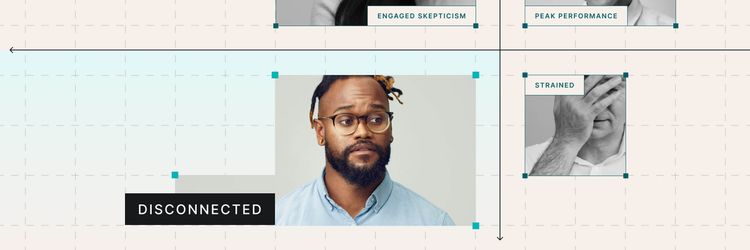
Disconnected cultures sit kitty-corner from Peak Performance cultures, which boast both high engagement and performance confidence. In Peak organizations, employees are more likely to feel supported by leadership, connected to organizational goals, and motivated to do their best work.
That difference matters. Peak organizations with connected, high-trust cultures are better positioned to retain talent, sustain performance, and create the clarity workers need to thrive, especially during periods of uncertainty. In fact, compared to organizations in other cultural states, Peak Performance companies report:
21% more high performers
Higher retention rates (88%)
Median stock price growth of up to 21% over one year
Building a strong culture takes intentional investment, but the payoff extends far beyond employee sentiment. High-trust cultures strengthen performance, improve retention, and give organizations a lasting competitive edge.
Concerned that your employees may be feeling disengaged and doubtful about your organization’s direction? Let’s explore whether your business’ culture may fall into the Disconnected culture state.
To find out if your organization has a Disconnected culture, ask yourself these seven questions:
Do survey responses suggest that employees don’t feel supported enough to succeed in their roles?
When you announce a quarterly/annual strategy, do you only hear from the same few people who cheer it on?
Do employees seem checked out and lacking curiosity about changes they’re expected to adopt?
Do employees talk about the future like it is something happening to them, rather than something they’re a part of building?
Do survey results show that employees understand how their day-to-day work relates to larger organizational goals?
When priorities shift, do people seem confused about what matters most or how success will be measured?
Do employees hesitate to ask for support, feedback, or clarity?
If you answered “yes” to most of these questions, your organization may be operating in a Disconnected cultural state. The good news is that your culture isn’t fixed. With the right people and culture strategy, organizations can implement lasting change and shift toward a more confident, high-performing culture. In the next section, we’ll explore just how.
So, how can organizations in a Disconnected state improve performance confidence and engagement? And where should leaders focus first?
Employees in Disconnected cultures can absolutely be reengaged, but meaningful change requires more than surface-level fixes. Our research team found that companies had to improve 10-12% points to get to Peak in one year.
To break long-standing patterns, employees need to see clear shifts in leadership, communication, and organizational direction. They need confidence that the organization has a plan for the future – and that their work plays an important role in it.
Here are the three areas of focus that can move an organization from a Disconnected culture to Peak Performance.
For employees to feel confident in leadership, they need to believe leaders can navigate uncertainty, make smart decisions, and communicate clearly about what comes next. That means leaders can’t be distant or reactive. Regular facetime, ongoing communication and transparency, and following through on promises all play a critical role in rebuilding employee trust.
Whether it’s holding recurring all-hands meetings, hosting Ask-Me-Anything sessions with executives, or openly sharing organizational priorities and challenges, these initiatives can improve leadership visibility and help employees feel more informed, included, and connected to the people shaping the future of your business. These are likely some of the things companies that moved into Peak from Disconnected did to boost leadership confidence by 10% points.
Employees are more engaged when they understand where the organization is headed and how their work contributes to that vision.
Organizations that moved into Peak Performance made significant gains (+11% points in one year) in creating a motivating vision and helping employees connect their day-to-day work to broader organizational goals. In practice, that can look like:
Using the objective and key results (OKRs) framework to connect employee goals to larger organizational priorities
Bringing customer stories directly to employees to reinforce the real-world impact of their work
Celebrating team wins and major milestones to build momentum and reinforce purpose
Repeating organizational priorities consistently so employees know what matters most and where to focus
When people understand the “why” behind their work, performance confidence grows. This can inspire employees to feel more connected to your organization, motivated in their roles, and confident that their work makes a meaningful difference.
Disconnected cultures often struggle with stagnation. Employees may feel hesitant to share ideas or uncertain whether innovation is even valued within their organization. Over time, people stop looking for better ways to work and simply focus on keeping the lights on. In companies that moved from Disconnected to Peak in one year, employee assessment of innovation rose by 10% points.
In contrast, Peak Performance organizations create space for employees to experiment and solve problems. Building that kind of environment starts with psychological safety – employees need to feel comfortable speaking up and taking risks without fear of backlash.
Organizations can encourage innovation by:
Giving employees the autonomy and resources to test new ideas and approaches
Creating dedicated time for brainstorming and problem-solving
Investing in continuous learning and skill development
Encouraging managers to model curiosity, adaptability, and openness to feedback
Recognizing employees who identify improvements or drive positive change
Over time, these actions help reset cultural norms, creating a workplace that empowers employees to be more engaged and confident that their ideas and contributions matter.
The shift from disconnected to Peak Performance isn’t just possible – it can happen quickly. Roughly one-quarter of organizations in non-Peak cultural states reached Peak Performance within a year.
Among organizations that made the leap, the biggest improvements included:
Effectively directing resources (+12 percentage points)
Creating a motivating vision (+11 points)
Taking visible action on survey feedback (+11 points)
Building confidence in leaders (+11 points)
Encouraging innovation and acting on employee ideas (+10 points)
Of course, every culture is different, which means the path forward for your organization might call for other improvements. For guidance on next steps, rely on regular employee feedback from surveys to identify cultural trends, uncover root causes of disengagement, and better understand which changes will have the biggest impact on your workplace.
Most importantly, employees need to see action. When organizations listen, communicate transparently, and make visible improvements based on feedback, trust and performance confidence begin to grow.
A Disconnected culture can signal uncertainty about leadership, strategy, or the organization's future. But it’s not a mark of failure – it’s an opportunity to improve.
With clear communication from your leadership team, a compelling vision, and practices that support innovation and growth, organizations can rebuild trust, strengthen engagement, and help employees feel more confident in where the business is headed.
The first step is understanding where your organization stands today. Explore your place on the PCQ quadrant and discover the path toward Peak Performance with Culture Amp’s CultureOS.

Unlock the 47% advantage: A guide for modern leaders.
Article
Article
Article